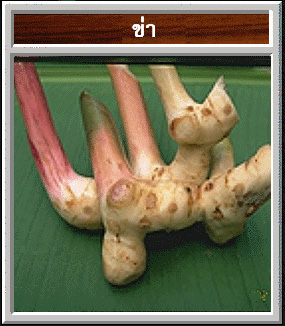
1. ชื่อสมุนไพร ข่า
ชื่อวิทยาศาสตร์ Alpinia galanga (Linn.) Swartz.
ชื่อวงศ์ ZINGIBERACEAE
ชื่อพ้อง Languas galanga (Linn.) Stuntz.
ชื่ออังกฤษ Galangal, False galangal, Greater galanga
ชื่อท้องถิ่น กฏุกกโรหิณี, ข่าหยวก, ข่าหลวง, สะเอเชย, เสะเออเคย
2. ลักษณะทางพฤกษศาสตร์
พืชล้มลุก มีเหง้าใต้ดิน เหง้ามีข้อหรือปล้องเห็นได้ชัด ใบเป็นใบเดี่ยว ออกเรียงสลับกัน ใบรูปหอกมีปลายแหลม รูปรีหรือเกือบขอบขนาน ปลายใบแหลม ขอบใบเรียบ โคนใบแหลมก้านใบมีขนเล็กน้อย กาบใบแผ่ออกหุ้มต้น ดอกเป็นช่อออกที่ปลายยอด ก้านช่อมีผิวเกลี้ยง ไม่มีขน แต่แกนกลางช่อมีขน ดอกมีขนาดเล็ก ใบประดับรูปไข่ กลีบเลี้ยงสีขาวอมเขียว มีขน โคนกลีบเลี้ยงเชื่อมติดกัน ปลายแยกเป็นหยักมนๆ กลีบดอกมีโคนเชื่อมติดกันเป็นหลอดสั้นๆ ปลายแยกเป็น 3 กลีบ มีกลีบบนหนึ่งกลีบ กลีบล่างสองกลีบ
ที่โคนกลีบดอกมีผลรูปกลมหรือรี สีแดงอมส้ม เมื่อแก่จัดจะเปลี่ยนเป็นสีดำ ภายในมี 2-3 เมล็ด
3. ส่วนที่ใช้เป็นยาและสรรพคุณ
- เหง้า รักษาอาการแน่นจุกเสียด
4. สารสำคัญที่เชื่อว่าเป็นสารออกฤทธิ์ หรือสารที่ใช้ประเมินคุณภาพของสมุนไพร
Cineole (1, 2), camphor (2, 3) และ eugenol (4) ลดการบีบตัวของลำไส้, 1'-acetoxychavicol acetate, 1'-acetoxyeugenol acetate (5) และ eugenol (6) ช่วยลดการอักเสบ (5, 6), 1'-acetoxychavicol acetate (7, 8) และ 1'-acetoxyeugenol acetate (7) ช่วยยับยั้งการเกิดแผลในกระเพาะอาหาร (7, 8) และฆ่าเชื้อรา (9) eugenol มีฤทธิ์ขับน้ำดี ช่วยย่อยอาหาร (10) และฆ่าเชื้อแบคทีเรีย (11)
5. ฤทธิ์ทางเภสัชวิทยา
5.1 ฤทธิ์ลดการบีบตัวของลำไส้
สารออกฤทธิ์ คือ cineole (1, 2), camphor (2, 3) และ eugenol (4) ในข่ามีฤทธิ์ลดการบีบตัวของลำไส้
5.2 ฤทธิ์ขับน้ำดี
สาร eugenol จากเหง้าข่ามีฤทธิ์ขับน้ำดี ช่วยย่อยอาหารได้ (10)
5.3 ฤทธิ์ขับลม
น้ำมันหอมระเหยจากเหง้าข่ามีฤทธิ์ขับลม (12)
5.4 ฤทธิ์ลดการอักเสบ
ข่ามีสารออกฤทธิ์ คือ 1'-acetoxychavicol acetate, 1'-acetoxyeugenol acetate (5) และ eugenol (6) ช่วยลดการอักเสบ (5, 6) และสมุนไพรตำรับที่มีข่าเป็นส่วนประกอบมีฤทธิ์ลดการอักเสบได้ (13, 14) สารสกัดข่าสามารถยับยั้งการสลายของกระดูกอ่อนจากการเหนี่ยวนำด้วย interleukin-1b (IL-1β) โดยพบสารออกฤทธิ์คือ p-hydroxycinnamaldehyde ซึ่งแยกได้จากสารสกัดข่าด้วยอะซีโตน มีฤทธิ์ยับยั้งการสลาย hyaluronan (HA), sulfated glycosaminoglycans (s-GAGs) และ matrix metalloproteinase (MMPs) จากเนื้อเยื่อกระดูกอ่อน แสดงว่าสาร p-hydroxycinnamaldehyde จากข่ามีศักยภาพที่จะพัฒนาไปใช้รักษาอาการข้ออักเสบได้ (15)
นอกจากนี้ยังพบว่าสารสกัดผสมของข่าและขิงมีประสิทธิภาพในการลดการอักเสบของข้อโดยการลด chemokine mRNA และระดับของโปรตีนที่ chemokine หลั่งออกมาได้ดีกว่าสารสกัดข่าหรือขิงเดี่ยวๆ (16) และพบว่าสารสกัดผสมข่าและขิงมีฤทธิ์ยับยั้งการแสดงออกของยีนของสารสื่อที่กระตุ้นให้เกิดการอักเสบ (proinflammatory genes) ได้แก่ TNF-a, IL-1b, COX-2, MIP-a, MCP-1 และ IP-10 (17)
5.5 ฤทธิ์ยับยั้งแผลในกระเพาะอาหาร
เหง้าข่ามีสาร 1'S-1'-acetoxychavicol acetate (7, 8) และ 1'S-1'-acetoxyeugenol acetate (7) ช่วยยับยั้งแผลในกระเพาะอาหาร (7, 8, 18)
5.6 ฤทธิ์ต้านเชื้อจุลชีพ
สารสกัดข่าด้วยปิโตรเลียมอีเธอร์, ไดเอทิลอีเธอร์, อะซีโตน และน้ำสามารถฆ่าเชื้อแบคทีเรีย Escherichia coli และ Salmonella typhi (19, 20) ที่เป็นสาเหตุของโรคอุจจาระร่วงได้ โดยมี eugenol (11) และ 1'-acetoxychavicol acetate (20) เป็นสารสำคัญในการออกฤทธิ์ฆ่าเชื้อแบคทีเรีย สาร 1'-acetoxychavicol acetate สามารถยับยั้งแบคทีเรียสายพันธุ์ดื้อยา Enterococcus faecalis, S. typhi, Pseudomonas aeruginosa, E coli และ Bacillus cereus ได้ด้วย (20)
สารสกัดข่าด้วยเอทานอลมีฤทธิ์ต้านเชื้อ Staphylococcus aureus (21, 22) โดยทำลายผนังเซลล์ทั้งชั้นในและชั้นนอกของแบคทีเรีย และพบสารสำคัญที่ออกฤทธิ์คือ 1'-acetoxychavicol acetate (21) การวิเคราะห์หาองค์ประกอบของสารสกัดข่า พบว่าประกอบด้วยสาร 1,8-cineole (ร้อยละ 20.95), beta-bisabolene (ร้อยละ 13.16), beta-caryophyllene (ร้อยละ 17.95) และ beta-selinene (ร้อยละ 10.56) (22)
สารสกัดข่าสด และสารสกัดน้ำมันข่าสามารถยับยั้งเชื้อ S. aureus, Bacillus cereus และ Salmonella typhi ในจานเลี้ยงเชื้อได้ โดยสารสกัดด้วยน้ำมันจะออกฤทธิ์ดีกว่าสารสกัดข่าสด (23) น้ำมันหอมระเหยจากข่ามีฤทธิ์ต้านเชื้อแบคทีเรียก่อโรคที่พบในอาหาร Campylobacter jejuni ได้ปานกลาง (24) สารสกัดข่าด้วยเอทิลอะซีเตตสามารถยับยั้งแบคทีเรียที่ทำให้เกิดสิว Propionibacterium acnes ได้ (25) นอกจากนี้สารสกัดข่าด้วยเอทิลแอลกอฮอล์มีฤทธิ์ยับยั้งเชื้อแบคทีเรียก่อโรคพืช Lemma minor ได้ (26) ผงเครื่องเทศและข่าร้อยละ 2 มีฤทธิ์ยับยั้งเชื้อ Salmonella typhimurium ในจานเลี้ยงเชื้อได้ (27)
สารสกัดข่าสามารถรักษากลากได้เมื่อเปรียบเทียบกับ tolnaftate (ยารักษากลาก) (28) สารสกัดข่าด้วยน้ำกลั่น (29, 30), เมทานอล (30), ไดคลอโรมีเทน (30) , เฮกเซน (30) หรือแอลกอฮอล์ (31) สามารถฆ่าเชื้อรา Microsporum gypseum (29-36), Trichophyton rubrum (29-33) และ Trichophyton mentagrophyte (9, 29-31, 34-36) ที่เป็นสาเหตุของโรคกลากเกลื้อนได้ โดยพบว่า 1'-acetoxychavicol acetate และ 1'-acetoxyeugenol acetate เป็นสารสำคัญในการออกฤทธิ์ฆ่าเชื้อรา (9) สารสกัดข่ามีฤทธิ์ต้านเชื้อรา Candida albicans (37) สารสกัดข่าด้วยเอทิลแอลกอฮอล์มีฤทธิ์ยับยั้งเชื้อราก่อโรคพืช Trichophyton longifosus ได้ร้อยละ 60 (26) นอกจากนี้ยังพบสารประกอบไดเทอร์พีนจากสารสกัดเมล็ดข่าแห้งด้วยเมทานอล 2 ชนิดคือ galanal A และ galanal B มีฤทธิ์ต้านเชื้อรา (38)
5.7 ฤทธิ์ต้านเซลล์มะเร็ง
สารสกัดเหง้าข่าด้วยเมทานอลมีฤทธิ์ต้านเซลล์มะเร็งต่อมน้ำเหลือง Raji (44) สารสกัดข่าทำให้เซลล์มะเร็งมดลูกไวต่อยา daunomycin มากขึ้น (47) สาร galanolactone และ (E)-8b(17)-epoxylabd-12-ene-15,16-dial จากเหง้าข่าเป็นพิษอย่างอ่อนต่อเซลล์มะเร็งชนิด 9KB (45) ขณะที่สารสกัดเหง้าข่าด้วยเอทานอลร้อยละ 50 จะไม่เป็นพิษต่อเซลล์นี้ (39, 40) น้ำมันหอมระเหยจากเหง้าข่า ซึ่งประกอบด้วยสารหลักคือ trans-3-acetoxy-1,8-cineole มีฤทธิ์ต้านเซลล์มะเร็งเต้านม (48) สารประกอบไดเทอร์พีนจากสารสกัดเมล็ดข่าแห้งด้วยเมทานอล ได้แก่ galanolactone, (E)-8 (17)-12-labddiene-15,16-dial, (E)-8b (17)-epoxylabd-12-ene-15,16-dial, galanal A และ galanal B มีฤทธิ์เป็นพิษต่อเซลล์ (38) สาร 1'S-1'-acetoxychavicol acetate และ p-coumaryl alc γ-O-methyl ether ที่แยกจากสารสกัดเหง้าข่าเป็นพิษต่อเซลล์มะเร็งมนุษย์ที่นำมาทดสอบ โดยสาร 1'S-1'-acetoxychavicol acetate มีฤทธิ์ต้านเซลล์มะเร็งปอด เซลล์มะเร็งกระเพาะอาหาร เซลล์มะเร็งลำไส้ใหญ่ เซลล์มะเร็งชนิดที่แพร่กระจายได้รวดเร็ว (HT1080) และเซลล์มะเร็งเม็ดเลือด และสาร p-coumaryl alcohol, γ-O-methyl ether มีฤทธิ์ต้านเซลล์มะเร็ง SNU638 (49) สารสกัดข่าซึ่งมี 1'-acetoxychavicol acetate เป็นสารประกอบหลักจะเป็นพิษต่อเซลล์มะเร็งปอด และเซลล์มะเร็งเต้านม (50)
6. อาการข้างเคียง
ยังไม่มีรายงาน
7. ความเป็นพิษทั่วไปและต่อระบบสืบพันธุ์
7.1 การทดสอบความเป็นพิษ
สารสกัดข่าด้วยเอทานอลร้อยละ 50 ไม่พบความเป็นพิษเมื่อให้ทางปากหรือฉีดเข้าใต้ผิวหนังหนูเม้าส์ (42) แต่มีความเป็นพิษปานกลางถึงมากเมื่อฉีดเข้าช่องท้องหนูเม้าส์ (39, 40) สารสกัดเหง้าข่าด้วยเอทานอลร้อยละ 95 ไม่พบความเป็นพิษเมื่อให้หนูเม้าส์ทางปากในขนาด 3 กรัม/กิโลกรัม (43) น้ำมันหอมระเหยจากเหง้าข่ามีความเป็นพิษปานกลางเมื่อฉีดเข้าช่องท้องหนูตะเภา (41) สารสกัดแอลกอฮอล์จากเหง้าข่าขนาด 100 มิลลิลิตร/กิโลกรัม ไม่พบความเป็นพิษเมื่อฉีดเข้าช่องท้องหนูเมาส์ติดต่อกัน 7 วัน (31)
การทดสอบความเป็นพิษกึ่งเรื้อรัง พบว่าสารสกัดข่าด้วย เอทานอลร้อยละ 95 ให้หนูเม้าส์โดยผสมกับน้ำดื่มในขนาด 100 มิลลิกรัม/กิโลกรัม ติดต่อกัน 3 เดือน ทำให้หนูตายถึงร้อยละ 15 (43)
7.2 พิษต่อเซลล์
สารสกัดด้วยน้ำของเหง้าข่ามีความเป็นพิษต่อเซลล์ผิวหนัง และเซลล์เต้านมชนิดที่ไม่ใช่เซลล์มะเร็ง นอกจากนี้ยังพบว่าสารสกัดข่าด้วยตัวทำละลายหลายชนิดมีความเป็นพิษต่อเซลล์มะเร็งปอด เซลล์มะเร็งเต้านมและเซลล์เต้านมชนิดที่ไม่ใช่เซลล์มะเร็ง และทำให้เกิดการทำลายของ DNA สายเดี่ยวของเซลล์ทุกชนิดที่ทดสอบ (46)
7.3 ฤทธิ์ก่อกลายพันธุ์
สารสกัดเหง้าข่าด้วยน้ำและน้ำร้อน ขนาด 0.5 มิลลิลิตร/จานเพาะเชื้อ และเหง้าข่าสด ไม่มีฤทธิ์ก่อกลายพันธุ์ต่อเชื้อ Bacillus subtilis H-17 (Rec+) และ M-45 (Rec-) (51) สารสกัดทิงเจอร์ ขนาด 80 ไมโครลิตร/จานเพาะเชื้อ ไม่มีฤทธิ์ก่อกลายพันธุ์ต่อเชื้อ Salmonella typhimurium TA 98, 100 (52) สารสกัดเหง้าข่าด้วยเมทิลแอลกอฮอล์มีฤทธิ์ต้านการก่อกลายพันธุ์ที่เกิดจาก อะฟลาท็อกซิน บี1 ต่อเชื้อ Salmonell typhimurium TA 98 (53)
8. วิธีการใช้
8.1 ตามคำแนะนำของกระทรวงสาธารณสุข (สาธารณสุขมูลฐาน)
1 ใช้ข่ารักษาอาการแน่นจุกเสียด
- ใช้เหง้าสด 5 กรัม หรือเหง้าแห้ง 2 กรัม ต้มกับน้ำจนเดือด รินน้ำดื่ม (54)
- ใช้หัวข่าตำละเอียดผสมน้ำปูนใส 2 แก้ว นำมาดื่ม (55)
2 ใช้ข่ารักษากลาก เกลื้อน
- ใช้เหง้าสดโขลกกับเหล้าโรง หรือน้ำส้มสายชู หรือเหง้าสดตำแช่แอลกอฮอล์ทา (54)
- ใช้เหง้าข่าปอกเปลือก จุ่มเหล้าแล้วเอามาทาบริเวณที่เป็นเกลื้อน ทาแรงๆ ทำเช่นนี้ 4-5 วัน ก็จะหาย (56)
- ใช้เหง้าข่าแก่ๆ ล้างให้สะอาดฝานเป็นแว่นบางๆ หรือทุบพอแตก นำไปแช่เหล้าขาวทิ้งไว้สัก 1 คืน ทำความสะอาดขัดถูบริเวณที่เป็นเกลื้อนจนพอแดงและแสบ แล้วเอาข่าที่แช่ไว้มาทาเฉพาะบริเวณที่เป็นเกลื้อน จะรู้สึกแสบๆ เย็นๆ ทาเช้าและเย็นหลังอาบน้ำทุกวัน ประมาณ 2 สัปดาห์ เกลื้อนจะจางลง และหายไปในที่สุด (57)
- ใช้เหง้าข่าล้างให้สะอาด ฝานเป็นแผ่นบางๆ นำไปแช่เหล้า 35 ดีกรี ประมาณ 5 นาที แล้วทาที่มีผื่นคัน อาการจะหายไป และถ้าแช่ค้างคืนจะใช้รักษาเกลื้อนได้ดี (58)
- ใช้เหง้าข่าสดตัดท่อนละ 1 นิ้ว ทุบให้แตกพอช้ำอย่าถึงกับละเอียด ใส่ถ้วยแช่เหล้าโรงประมาณ 1/4 ถ้วยชา ใช้สำลีชุบทาวันละครั้ง (59)
- ใช้เหง้าข่าแก่ๆ นำมาตำพอแหลก แล้วผสมเหล้าหรืออัลกอฮอล์ แช่ไว้ 1 คืน ใช้ทาแก้เกลื้อน หรือกลาก (60, 61)
8.2 ยาจากสมุนไพรในบัญชียาหลักแห่งชาติ
ไม่มี
เอกสารอ้างอิง
1. Haginiwa J, Harada M, Morishita I. Properties of essential oil components of aromatics and their pharmacological effect on mouse intestine. Pharmacological studies on crud drugs. VII. Yakugaku Zasshi 1963;83:624.
2. Evans BK, James KC, Luscombe DK. Quantitative structure-activity relationships and carminative activity. J Pharm Sci 1978;6:227.
3. Cabo J, Crespo ME, Jimenez J, Zarzvelo A. The activity of the major components of their essential oils. The spasmolytic activity of various aromatic plants from the province of granada. I. Plant Med Phytother 1986;203:213-8.
4. Bennett A,Stamford IF, Tavares IA, Jacobs S, et al. Studies on prostaglandins, the intestine and other tissues. The Biological activity of eugenol, a major constituent of nutmeg (Myristica Fragrans). Phytother Res 23 1988;23:124-30.
5. Yu J, Fang H, Chen Y, Yao Z. Identification of the chemical components of two Alpinia species. Zhongyao Tongbao 1988;13(6):354-6.
6. Dewhirst FE. Eugenol, a prototype phenolic prostaglandin synthetase inhibitor, it's anti-inflammatory activity, its effects on sheep vestebular. Rochester University 1979:191.
7. Matsuda H, Pongpiriyadacha Y, Morikawa T, Momotaro O, Yoshikawa M. Gastroprotective effects of phenylpropanoids from the rhizomes of Alpinia galanga in rats: structural requirements and mode of action. Eur J Pharmacol 2003;471(1):59-67.
8. Ogiso A, Kobayashi S. Antiulcer agents from Alpinia seeds. Patent:Japan Kokai 74 36, 817 1974.
9. Jassen AM, Scheffer JJC. Acetoxyhydroxychavicol acetate, an antifungal component of Alpinia galanga. Planta Med 1985;6:507-11.
10. Yamahara J, Kobayashi M, Saiki Y, Sawada T, Fujimura H. Biologically active principles of crud drugs: Pharmacological evaluation of cholagogue substances in clove and its properties. J Pharmacobio-Dyn 1983;6(5):281-6.
11. Okazaki K, Oshima S. Antibacterial activity of higher plants. XX. Antimicrobial effect of essential oils. (1). Clove oil and eugenol. J Pharm Soc Japan 1952;72:558-60.
12. Ross MSF, Brain KR. An introduction to phytopharmacy. London: Pitman Publishing Co.Ltd., 1977. p.158-76.
13. Sundari SKK, Valarmathi R, Dayabaran D, Mohamed PN. Studies on the anti-inflammatory activity of Gugula Thiktha Kashayam (GTK). Indian drugs 2001;38(7)380-2.
14. Venkataranganna MV, Gopumadhavan S, Mitra SK, Anturlikar SD. Anti-inflammatory activity of JCB, a polyherbal formation. Indian drugs 2000;37(11):543-6.
15. Phitak T, Choocheep K, Pothacharoen P, Pompimon W, Premanode B, Kongtawelert P. The effects of p-hydroxycinnamaldehyde from Alpinia galanga extracts on human chondrocytes. Phytochemistry 2009;70(2): 237-43.
16. Phan Phong V, Sohrabi A, Polotsky A, Hungerford DS, Lindmark L, Frondosa CG. Ginger extract components suppress induction of chemokine expression in human synoviocytes. J Altern Complement Med 2005;11(1):149-54.
17. Grzanna R, Phan P, Polotsky A, Lindmark L, Frondosa CG. Ginger extract inhibits beta-amyloid peptide-induced cytokine and chemokine expression in cultured THP-1 monocytes. J Altern Complement Med 2004; 10(6): 1009-13.
18. Pongpiriyadacha Y. Gastroprotective constituents from Tasmannia lanceolata, Alpinia galangal, and Paris polyphylla. M.Sc in Pharm Thesis, Kyoto Pharmaceutical University. 2002; 70p.
19. แสงจันทร์ เอี่ยมธรรมชาติ. การศึกษาผลของสมุนไพรบางชนิดในวงศ์ซิงกิเบอเรซี (Zingiberaceae) ต่อการเจริญของแบคทีเรียบางชนิด. รวมบทคัดย่องานวิจัยการแพทย์แผนไทยและทิศทางการวิจัยในอนาคต, สถาบันการแพทย์แผนไทย, 2543.
20. Latha C, Shriram VD, Jahagirdar SS, Dhakephalkar PK, Rojatkar SR. Antiplasmid activity of 1'-acetoxychavicol acetate from Alpinia galangal against multi-drug resistant bacteria. J Ethnopharmacol 2009;123:522-5.
21. Oonmetta-aree J, Suzuki T, Gasaluck P, Eumkeb G. Antimicrobial properties and action of galangal (Alpinia galangal Linn.) on Staphylococcus aureus. LWT 2006;39:1214-20.
22. Mayachiew P, Devahastin S. Antimicrobial and antioxidant activities of Indian gooseberry and galangal extracts. LWT 2008;41:1153-59.
23. Chaisawadi S, Thongbutr D, Methawiriyasilp W, Chaisawadi A, Pitakworarat N, Jaturonrasamee K, Khemkhaw J, Tanuthumchareon W.Preliminary study of antimicrobial activities on medicinal on herbs of Thai food’s ingredients. The 3rd World Congress on Medicinal Plant and Aromatic Plants for Human Welfare, 3-7 Feb, Chiang Mai, Thailand, 2003.
24. Rattanachaikunsopon P, Phumkhachorn P. Potential of coriander (Coriandrum sativum) oil as a natural antimicrobial compound in controlling Campylobacter jejuni in raw meat. Biosci Biotechnol Biochem 2010;74(1):31-5.
25. Niyomkum P, Panichayupakaranant P. Screening of antibacterial activity against Propionibacterium acnes of Thai medicinal plant extracts. Proceedings of the 4th Indochina Conference on Pharmaceutical Sciences, 10-13 November, Vietnam, 2005.
26. Somia K, Saeed-ur-Rehman, Hamid US, Waqar A, Manzoor A. Biological effects of indigenous medicinal plants Curcuma longa and Alpinia galangal. Fitoterapia 2005;76(2):254-7.
27. สุดา ชูถิ่น ดวงรัตน์ มีผล นริศร แผนสูง วันทน สว่างอารมณ์. ประสิทธิภาพของผงเครื่องเทศ 8 ชนิด ในการยับยั้งการเจริญของเชื้อ Salmonella typhimurium. การประชุมวิชาการและเสนอผลงานวิจัยพืชเขตร้อนและกึ่งเขตร้อน ครั้งที่ 2, 21-22 สิงหาคม, กรุงเทพ, 2551.
28. Shaiphanich C, Wuthiudomlert M, Sawasdimongkol O, Saowakhont R. Languas galanga cream for treatment of ringworm. Report of medicinal plants for the primary health care project, 1984.
29. Sindhuphak R, Tirnapragit A, Gindamporn A, Sindhuphuk W. The antifungal activity of some Thai plants. Thai J Hlth Resch 1992;6(1):9-20.
30. ดำรง พงศ์พุทธชาติ. ผลยับยั้งของพืชสมุนไพรบางชนิดต่อเชื้อราที่ทำให้เกิดโรคผิวหนัง. รวมบทคัดย่องานวิจัยการแพทย์แผนไทยและทิศทางการวิจัยในอนาคต, สถาบันการแพทย์แผนไทย, 2543.
31. ศมนีย์ ศุขรุ่งเรือง. การพัฒนาข่าเมื่อใช้เป็นยารักษาโรคกลาก ภาค 1 การทดสอบฤทธิ์การต้านเชื้อราและพิษของข่าสกัด. หนังสือรวบรวมผลงานการวิจัย โครงการพัฒนาการใช้สมุนไพรและยาไทยทางคลินิก, มหาวิทยาลัยมหิดล, 2525-2536.
32. Limsrimanee S, Sriratana S. Inhibitory action of some Thai herbians (medicinal plants) to fungi. Special Project for The degree of Bachelor of Pharmacy. Mahidol Univ, Thailand, 1983.
33. Achararit C, Punyayong W, Ruchatakomut E. Antifungal activity of some Thai medicinal plants. Special Project for The degree of Bachelor of Pharmacy. Bangkok: Mahidol University, 1983.
34. Trakranrungsie N, Chatchawanchonteera A, Khunkitti W. Comparative anti-dermatophytic effect of Piper betle, Alpenia galanga and Allium ascalonicum extracts. The sixth JSPS-NRCT joint seminar: recent advances in natural medicine research, 2-4 Dec, Bangkok, Thailand, 2003.
35. Chatchawanchonteera A, Suriyasathaporn W, Trakranrungsie N. Antifungal activity of Alpinia galanga and Allium ascalonicum extract. Thai J Pharmacol 2003;25(1): 85.
36. Ficker CE, Smith ML, Susiarti S, Leaman DJ, Irawati C, Arnason JT. Inhibition of human pathogenic fungi by members of Zingiberaceae used by the Kenyah (Indonesian Borneo). J Ethnopharmacol 2003;85:289-93.
37. Saraya S, Puttikulbovorn J, Temsiririrkkul R. Herbal denture cleansing solution. 3rd Asian Pacific Region Meeting, 10-12 May, Bangkok Thailand, 2009
38. Morita H, Itokawa H. Cytotoxic and antifungal diterpenes from the seeds of Alpinia galanga. Planta Medica 1988;54(2):117-20.
39. Murakami A, Kondo A, Nakamura Y, Ohigashi H, Koshimizu K. Possible anti-tumor promoting properties of edible plants from Thailand, and identification of an active constituent, cardamonin, of Boesenbergia. Biosci Biotech Biochem 1993;57(11):1971-3.
40. Go EJ, Kim HR, Chung SY, Jeong Y-H, Kim NH, Han A-R, Seo E-K, Lee HJ. Evaluation on the P-glycoprotein inhibitory activity of Indonesian medicinal plants. Nat Prod Sci 2004;10(2):85-8.
41. Singh M, Pal M, Sharma RP. Biological activity of the labdane diterpenes. Planta Med 1999;65:2-8.
42. Bhakuni OS, Dhar ML, Dhar MM, Dhawan BN, Merotra BN. Screening of Indian plants for biological activity. Part II. Indian J Exp Biol 1969;7:250-62.
43. Dhawan BN, Patnaik GK, Rastogi RP, Singh KK, Tandon JS. Screening of Indian plants for biological activity. VI. Indian J Exp Biol 1977;15:208-19.
44. Zaeoung S, Plubrukarn A, Keawpradub N. Cytotoxic and free radical scavenging activities of Zingiberaceous rhizomes. Songklanakarin J Sci Technol 2005;27(4):799-812.
45. Nam J-W, Kim S-J, Han A-R, Lee SK, Seo E-K. Cytotoxic phenylpropanoids from the rhizomes of Alpinia galangal. J Appl Pharm 2005;13(4):263-6.
46. Lee CC, Houghton P. Cytotoxicity of plants from Malaysia and Thailand used traditionally to treat cancer. J Ethnopharmacol 2005;100:237-43.
47. Qureshi S, Shah AH, Ageel AM. Toxicity studies on Alpinia galanga and Curcuma longa. Planta Med 1992;58:124-7.
48. Mokkhasmit M, Swatdimongkol K, Satrawaha P. Study on toxicity of Thai medicinal plants. Bull Dept Med Sci. 1971;12(2/4):36-65.
49. Chopra IC, Khajuria BN, Chopra CL. Antibacterial properties of volatile principles from Alpinia galanga and Acorus calamus. Antibiot Chemother 1957;7:378.
50. Muangnoi P, Lu M, Lee J, Thepouyporn A, Mirzayans R, Le XC, Weinfeld M, Changbumrung S. Cytotoxicity, apoptosis and DNA damage induced by Alpinia galangal rhizome extract. Planta Med 2007;73:748-54.
51. Ungsurungsie M, Suthienkul O, Paovalo C. Mutagenicity screening of popular Thai spices. Food Chem Toxicol 1982;20:527-30.
52. Schimmer O,Kruger A, Paulini H, Haefele F. An evaluation of 66 commercial plant extracts in the Ames mutagenicity test. Pharmazie 1994;49(6):448-51.
53. Rearungchom T. Possible mechanism of inhibition of aflatoxin-B, mutagenesis by Thai medicinal plants, Murdannia loriformis and Alpinia galangal. Thesis (M. Sc.). Chiang Mai: Chiang Mai University, 1993.
54. กองวิจัยทางการแพทย์. สมุนไพรพื้นบ้าน ตอนที่1. กรุงเทพฯ: กรมวิทยาศาสตร์การแพทย์. กระทรวงสาธารณสุข, 2526. หน้า 22.
55. พระเทพวิมลโมลี. ตำรายากลางบ้าน. กรุงเทพฯ: โรงพิมพ์มหามงกุฏราชวิทยาลัย, 2524, หน้า 32.
56. อาจินต์ ปัญจพรรค์. เมืองไทย 16 ค่ำ. กรุงเทพฯ: โรงพิมพ์เจริญกิจ, 2517. หน้า 186.
57. อาจินต์ ปัญจพรรค์. ขุดทองในบ้าน. กรุงเทพฯ: โรงพิมพ์อนงค์ศิลป์การพิมพ์, 2524. หน้า 45.
58. อาจินต์ ปัญจพรรค์. เมืองไทย 16 ค่ำ. กรุงเทพฯ: โรงพิมพ์เจริญกิจ, 2517. หน้า 77.
59. อาจินต์ ปัญจพรรค์. เมืองไทยเดือน 3. กรุงเทพฯ: โรงพิมพ์เจริญกิจ, 2517. หน้า 82.
60. อาจินต์ ปัญจพรรค์. เมืองไทยอมตะ. กรุงเทพฯ: โรงพิมพ์เจริญกิจ, 2522. หน้า 32.
61. พระเทพวิมลโมลี. ตำรายากลางบ้าน. กรุงเทพฯ: โรงพิมพ์มหามงกุฏราชวิทยาลัย, 2524. หน้า 138.